
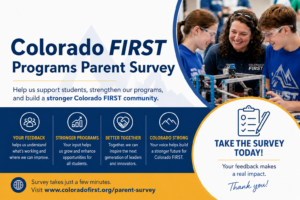
Colorado FIRST Programs Parent Survey
Thank you for taking a few minutes to complete this survey. Your feedback helps improve the FIRST Robotics programs and provides valuable data for grant
COLORADO FIRST ● FIRST Robotics Competition
FIRST Robotics Competition is an intensive, hands-on robotics program for high school students. Guided by adult mentors, teams design, build, program, and operate an industrial-sized robot to compete in a new game released each January.
Students work together through the complete engineering process while also developing skills in strategy, project management, fundraising,
communications, outreach, and leadership. Teams compete at Regional or District events and may qualify for the FIRST Championship.
FIRST Robotics Competition:
ESTABLISHED
Supporting FIRST programs in Colorado
ORGANIZATION
501(c)(3) nonprofit status since 2008
MISSION
Through robotics, STEM, mentorship, and teamwork
FIRST Robotics Competition is a high school robotics program in which students work with adult mentors to operate a team much like a small engineering organization. Teams recruit members, raise funds, manage a budget, develop a team identity, conduct community outreach, and design, build, program, and operate an industrial-sized robot.
Students can participate in mechanical design, programming, electronics, fabrication, CAD, strategy, scouting, business, media, fundraising, awards, outreach, and team leadership. Technical experience is not required to join, and successful teams provide meaningful roles for students with many different interests.
Each January, <em>FIRST</em> releases a new game with a unique field, scoring system, robot requirements, and competition rules. Teams then begin designing and building a robot that can complete that season’s challenges. Students prototype ideas, manufacture components, program the robot, test systems, develop match strategy, and practice driving.
Colorado operates under the Regional Event model. Colorado teams register for and attend one or more Regional Events rather than earning points through a series of District competitions.
A team’s initial FIRST season registration generally includes entry into one Regional Event. Teams may register for additional Regional Events when space is available, but each additional event requires a separate registration fee. Teams choose events based on location, schedule, travel requirements, available capacity, and team budget.
Regional Events usually take place over several days and include:
Before competing, every robot must pass inspection to confirm that it meets the current season’s construction, size, weight, electrical, software, and safety requirements.
In FIRST Robotics Competition, students do far more than build a robot. They work as members of a year-round team that functions much like a small engineering and business organization. Students identify problems, develop ideas, test solutions, make decisions, manage deadlines, and learn how their individual work contributes to a larger team goal.
Students may design mechanisms in CAD, manufacture parts, assemble the robot, wire electrical systems, write software, test controls, analyze game strategy, scout other teams, prepare award submissions, create media, manage outreach, raise funds, communicate with sponsors, and help lead the organization. These roles give students opportunities to explore both technical and nontechnical interests.
The work is intentionally hands-on. Students learn by building prototypes, making mistakes, evaluating results, and improving their designs. During competition season, they must balance performance, reliability, time, cost, safety, and the official game rules. At events, students repair and maintain the robot, develop match strategies, communicate with alliance partners, drive the robot, collect scouting data, and represent their team to judges, volunteers, sponsors, and other teams.
Mentors are a key part of the FIRST Robotics Competition experience because they connect student learning with real-world knowledge. Mentors may bring experience in engineering, manufacturing, programming, construction, education, business, project management, communications, finance, or youth development.
The most successful student-mentor relationship is a partnership. Mentors do not simply build the robot for the students, and students are not expected to solve every problem without support. Instead, mentors ask questions, demonstrate techniques, explain professional practices, help students evaluate options, and provide the structure needed to complete a complex project safely.
Students should remain active participants in the work and decisions. A mentor might teach a student how to use a tool, help a programming group diagnose a problem, review a design for safety, or guide the team through a difficult planning decision. The student then applies that knowledge, performs the work, and gradually takes on greater responsibility.
An FRC robot requires many different skills and must be completed within a demanding schedule. A strong mentor team helps students organize the work, use tools safely, understand technical concepts, manage setbacks, and maintain progress throughout the season.
Mentors also provide continuity from year to year. Students graduate, team leaders change, and new members join each season. Adult mentors help preserve the team’s knowledge, relationships, procedures, safety practices, and organizational history while creating opportunities for experienced students to teach younger members.
The goal is not for mentors to provide every answer. The goal is to create an environment where students are challenged, supported, and trusted to grow. When students and mentors work together effectively, students gain technical skills, confidence, leadership experience, professional connections, and a clearer understanding of education and career opportunities.
Colorado operates under the Regional Event model. Colorado teams register for and attend one or more Regional Events rather than earning points through a series of District competitions.
A team’s initial FIRST season registration generally includes entry into one Regional Event. Teams may register for additional Regional Events when space is available, but each additional event requires a separate registration fee. Teams choose events based on location, schedule, travel requirements, available capacity, and team budget.
Regional Events usually take place over several days and include:
Before competing, every robot must pass inspection to confirm that it meets the current season’s construction, size, weight, electrical, software, and safety requirements.
During qualification matches, teams are assigned to temporary three-team alliances. The alliance assignments change throughout the event, so teams compete both with and against many other teams.
Each match includes an autonomous period, during which robots operate through programmed instructions, followed by a driver-controlled period. Teams work together to score points and complete the game’s objectives.
Qualification results determine each team’s ranking at the event. Rankings are based on the official scoring and ranking-point system established for that season’s game.
After qualification matches, the highest-ranked teams participate in alliance selection. Alliance captains invite other teams to form permanent playoff alliances.
Those alliances compete through the playoff tournament until an event-winning alliance is determined. Because alliance selection considers robot performance, reliability, strategy, teamwork, and scouting information, a team does not necessarily need to be the highest-scoring robot to be selected for the playoffs.
Regional Events recognize teams through both competition performance and judged awards. Awards may recognize engineering, robot design, programming, outreach, team culture, student leadership, mentor contributions, creativity, and the team’s overall impact.
Colorado teams may qualify for the FIRST Championship through specific Regional Event achievements, including eligible competition results and qualifying awards. Advancement is determined separately at each Regional Event rather than through season-long District points.
Attending multiple Regional Events can provide a team with additional opportunities to compete and qualify, but each Regional is a complete and independent event.
FIRST Robotics Competition is designed primarily for high school students in grades 9–12, generally ages 14–18. Students do not need previous experience in robotics, engineering, programming, or manufacturing to join. Teams teach these skills through hands-on work, mentor guidance, training, and participation in the annual season.
Students with many different interests can participate. Technical roles include mechanical design, CAD, fabrication, electronics, programming, robot maintenance, strategy, scouting, and drive team responsibilities. Nontechnical roles include fundraising, budgeting, sponsor relations, marketing, photography, video, social media, outreach, awards, event planning, and team leadership.
There is no required ideal team size. Many teams have approximately 10–20 students, although teams may be smaller or much larger depending on their resources, workspace, mentor support, and organizational structure.
FRC teams may be organized through:
Students do not necessarily need to attend the same school. Community-based teams can include students from multiple schools, cities, or educational settings.
Each team also needs at least two adult lead coaches who help guide the team throughout the season. Additional mentors, parents, alumni, educators, and industry professionals may support technical training, business operations, transportation, fundraising, safety, and team administration.
The program works best when students with different strengths participate together. Some students may arrive with advanced technical skills, while others may be trying engineering, coding, communications, or leadership for the first time. Curiosity, commitment, teamwork, and a willingness to learn are more important than prior experience.
PLAN FOR SUSTAINABILITY
This example represents a developing FRC team attending one local Regional Event, operating from a basic workshop, and building a practical first-season robot. Actual costs will vary based on location, team size, travel, donated resources, and the complexity of the robot.
| Budget Item | Planning Notes | Estimated Cost |
|---|---|---|
| Competition and Registration | ||
| FIRST season registration Core expense | Includes the initial FRC registration package and participation in one Regional Event for a Regional team. | $6,500 |
| Registration-related costs | Shipping, payment fees, required documents, and other small registration expenses. | $300 |
| Robot, Field and Workshop | ||
| Additional robot parts Core expense | Motors, controllers, structural materials, hardware, electrical components, sensors, and replacement parts beyond the Kit of Parts. | $3,000 |
| Spares and batteries | Spare electrical components, additional batteries, chargers, wheels, belts, chain, fasteners, and common replacement items. | $1,200 |
| Prototyping and practice field | Wood, plastic, fasteners, game pieces, carpet, and simple field elements used for testing. | $500 |
| Basic workshop tools Startup cost | Hand tools, cordless tools, drill press or saw access, measuring tools, workbenches, storage, and basic electrical equipment. | $2,500 |
| Safety equipment | Safety glasses, first-aid supplies, hearing protection, gloves, guards, signage, and other shop-safety items. | $400 |
| Workspace and utilities | Modest annual allowance for space use, utilities, cleaning, storage, internet, or facility support. Enter $0 when space is donated. | $1,200 |
| Team Operations and Event Participation | ||
| Local transportation | Bus, van, trailer, fuel, parking, and local travel for one three-day Regional Event. | $1,200 |
| Event meals and snacks | Basic meals, water, snacks, and hospitality for students and adult mentors during the Regional. | $1,200 |
| Team shirts and identification | Team shirts, mentor shirts, name badges, pit signage, banners, and simple branding materials. | $600 |
| Business and outreach | Website, printing, sponsor materials, outreach supplies, awards preparation, and presentation materials. | $500 |
| Administration and insurance | Banking, accounting, background checks, insurance, licenses, software, or host-organization expenses. | $500 |
| Contingency and next-season reserve Recommended | Covers unexpected repairs or cost increases and provides a small starting balance for the next season. | $1,000 |
| Estimated Annual Total | $0 | |
Review current FIRST pricing and adjust every line for your team’s actual location, resources, goals, and travel requirements.
Nothing on Earth thrives in isolation. Every gene, species, and ecosystem are woven into a vibrant network of biodiversity that sustains the air we breathe, the water we drink, and the food that nourishes us.
The 2026-27 Biodiversity themed season will encourage students to use STEM as their guide and nature as their inspiration, allowing today’s innovators to discover creative ways to strengthen the systems that support life on our planet.
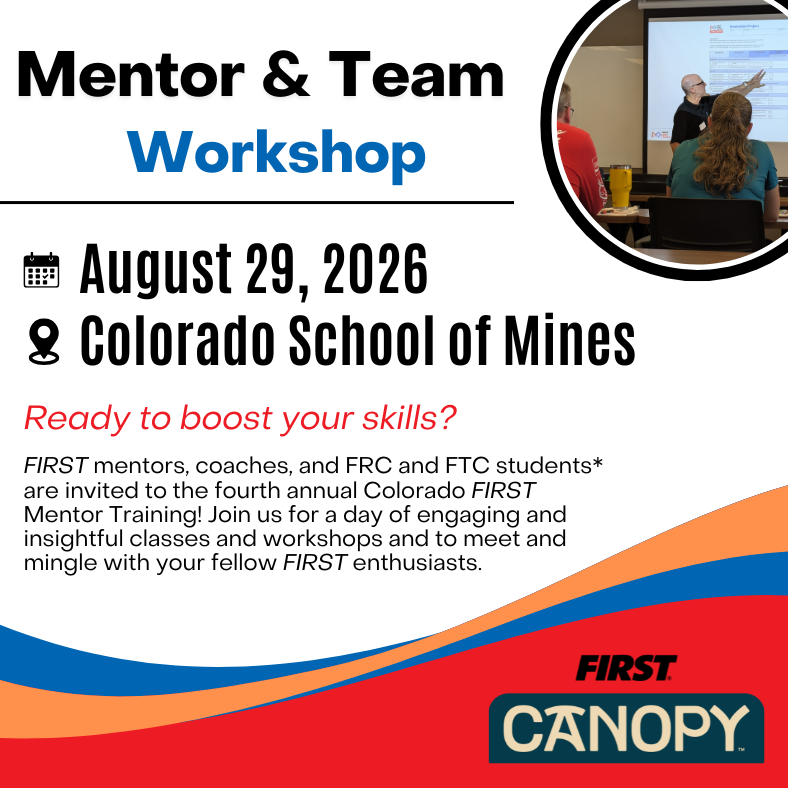
FIRST mentors, coaches, and FRC and FTC students are invited to the fourth annual Colorado FIRST Mentor Training! Join us for a day of engaging and insightful classes and workshops and to meet and mingle with your fellow FIRST enthusiasts.
Thank you for taking a few minutes to complete this survey. Your feedback helps improve the FIRST Robotics programs and provides valuable data for grant
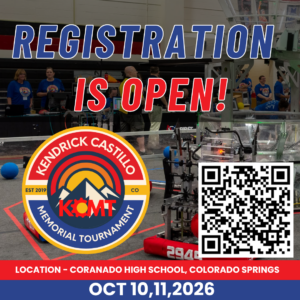
We excited for another year for this fun off-season event! Sign up soon! We will be at a different venue this year. Go to this